
 Cody Cooper
The Trump administration has announced a new 15% polysilicon tariff derivative products, along with minimum import price requirements, as part of a broader effort to strengthen U.S. manufacturing of critical materials used in solar panels and semiconductors. The measures follow a year-long national security investigation conducted under Section 232 of the Trade Expansion Act of 1962.
According to Reuters, the new policy applies to polysilicon derivatives, including wafers, solar cells, modules, and other downstream products made from polysilicon. In addition to the 15% tariff, the administration will establish minimum import prices for these products to prevent low-cost imports from undercutting domestic manufacturers. The proclamation is intended to address concerns that China’s heavily subsidized production has depressed global polysilicon prices and weakened U.S. manufacturing competitiveness.
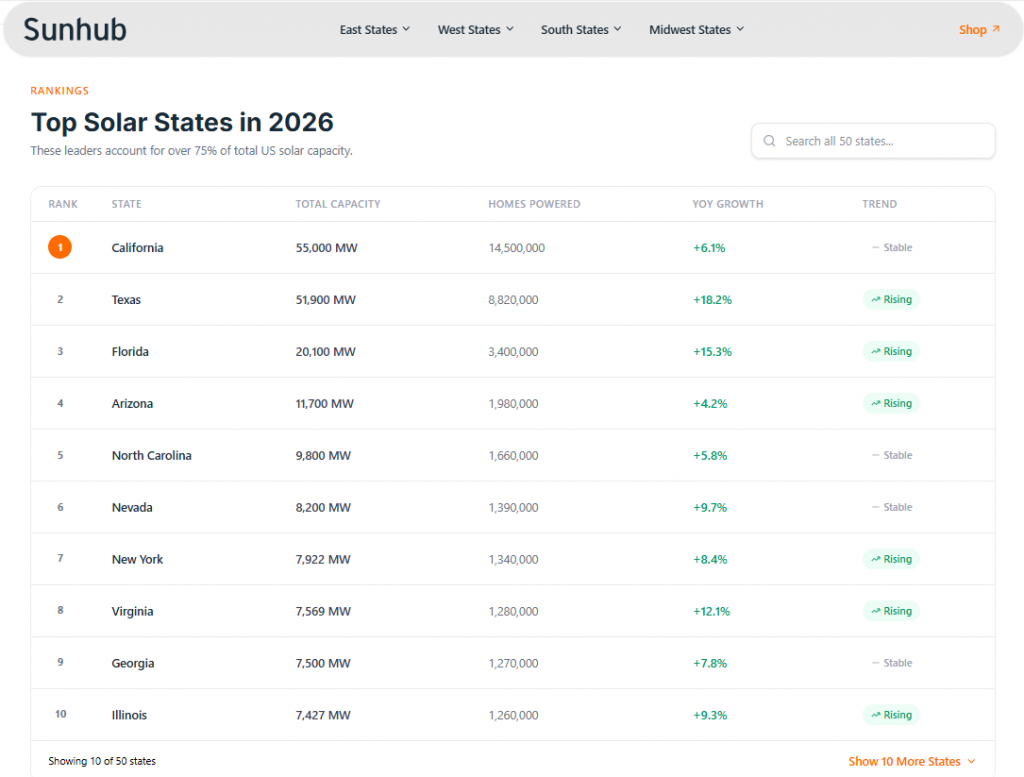
Explore U.S. Solar State Rankings
Compare solar rankings, installed capacity, growth trends, and market performance across all 50 states. Discover regional insights to support smarter procurement and expansion decisions.
Polysilicon is a critical raw material used to manufacture solar photovoltaic cells and semiconductor chips. While the United States remains one of the world’s leading producers of high-purity polysilicon, Chinese manufacturers dominate downstream processing into wafers, cells, and finished solar modules. Industry analysts say this imbalance has placed significant pressure on U.S. producers in recent years.
The administration’s decision follows recommendations from the Commerce Department’s Section 232 investigation, which concluded that dependence on foreign polysilicon products presents national security concerns because of their importance to the energy and semiconductor industries. Officials said the combination of tariffs and price floors is intended to encourage domestic investment while preventing foreign suppliers from circumventing trade measures through aggressive price reductions.
The policy has received mixed reactions across the solar industry. Domestic polysilicon manufacturers, including companies such as Hemlock Semiconductor and Wacker Chemie, are expected to benefit from stronger trade protections. However, some solar developers and equipment manufacturers have expressed concern that higher import costs could increase project expenses, particularly for utility-scale solar installations that rely on globally sourced components. (Reuters)
The announcement is the latest in a series of U.S. trade actions aimed at reshaping clean energy supply chains and reducing dependence on Chinese manufacturing. It follows previous tariffs on solar products, expanded domestic manufacturing incentives, and additional investigations into imports of solar equipment from several countries. Analysts expect the new measures to further accelerate investment in U.S.-based polysilicon and solar manufacturing while potentially increasing short-term costs for some renewable energy projects. (Reuters)


 Daniyal Ahmed
 Marley Kakusa



Add comment