
 Daniyal Ahmed
Solar Policies – State lawmakers across the United States significantly increased legislative activity supporting plug-in solar during the second quarter of 2026, reflecting growing interest in expanding access to low-cost distributed solar systems for renters and homeowners.
Plug-In Solar Emerges as a Growing Policy Area
According to the North Carolina Clean Energy Technology Center (NCCETC) and its latest U.S. State Solar Policy Report, states and utilities took 284 distributed solar policy actions during the second quarter of 2026, with plug-in solar emerging as one of the fastest-growing policy areas.
The report tracked legislative, regulatory, and utility actions between April and June 2026.
Five States Enact Plug-In Solar Legislation
During the quarter, Colorado, Connecticut, Maine, New Jersey, and Virginia enacted legislation establishing legal frameworks for plug-in, or “balcony,” solar systems.
These laws generally allow residents to connect small photovoltaic systems directly to standard household outlets while establishing safety requirements, equipment certification standards, and consumer protections.
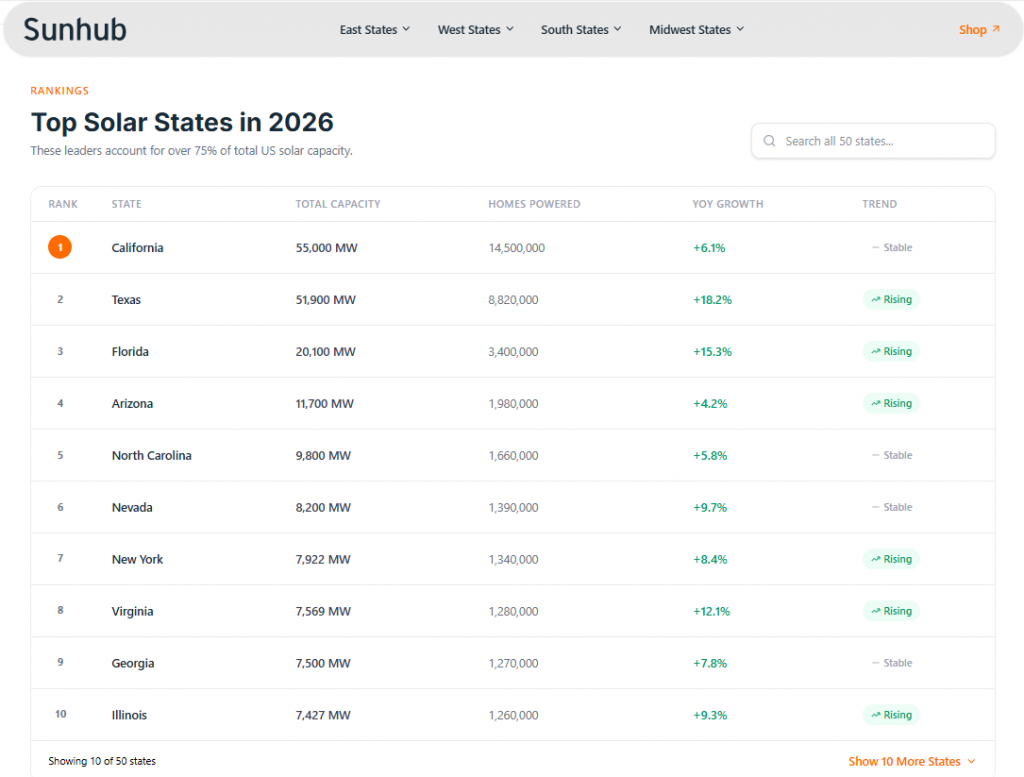
Explore U.S. Solar State Rankings
Compare solar rankings, installed capacity, growth trends, and market performance across all 50 states. Discover regional insights to support smarter procurement and expansion decisions.
Additional States Consider Similar Policies
Several additional states, including Iowa, Massachusetts, New York, Oregon, Rhode Island, Texas, and Washington, introduced similar legislation during the quarter but had not yet enacted the measures as of June 30.
Momentum has continued beyond the second quarter, with Iowa lawmakers continuing discussions on legislation that would authorize plug-in solar systems.
How Plug-In Solar Systems Work
Plug-in solar systems typically consist of one or two photovoltaic panels paired with a microinverter that plugs into a standard electrical outlet.
Because they require little or no permanent installation, they offer a lower-cost option for renters, apartment residents, and homeowners who cannot install conventional rooftop solar.
Industry groups estimate that eliminating permitting and professional installation requirements can reduce installation costs by roughly 50%.
States Continue to Address Distributed Solar Policies
Beyond plug-in solar, the NCCETC report found continued policy activity related to net metering, community solar, utility rate design, and distributed energy resources.
The organization said state legislatures and utility commissions remain active in shaping policies that affect residential and commercial solar deployment as states respond to rising electricity demand and evolving federal energy policies.
Residential Solar Market Records Continued Growth
The increased legislative activity comes as distributed solar continues to expand despite broader market challenges.
Separate data from the Solar Energy Industries Association (SEIA) and Wood Mackenzie show the U.S. installed 7.8 GWdc of new solar capacity during the first quarter of 2026.
While overall installations declined compared with a year earlier due to policy uncertainty and project timing, the residential market grew 6% year over year, underscoring continued consumer interest in small-scale solar technologies.
Sources
Sources include the North Carolina Clean Energy Technology Center’s The 50 States of Solar: Q2 2026 Quarterly Report, published through Solar Power World Online; National Conference of State Legislatures plug-in solar policy resources; the Solar Energy Industries Association and Wood Mackenzie’s U.S. Solar Market Insight Q2 2026; Axios reporting on Iowa plug-in solar legislation; and NCEL environmental policy resources.


 Marley Kakusa
 Cody Cooper



Add comment