
 Daniyal Ahmed
Agrivoltaics is gaining attention across Europe as a potential solution to growing competition between agricultural land and solar energy development. By combining electricity generation with crop cultivation or livestock grazing, the approach could help countries expand renewable energy capacity without completely removing productive farmland from agricultural use.
According to an October 11 report by Euronews, researchers, farmers and policymakers are exploring how agrivoltaic systems can support food production, improve land-use efficiency and provide additional income for agricultural communities.
The technology is being tested across Europe, including in Spain, Italy, France and Germany, where developers are experimenting with different solar panel configurations to accommodate agricultural activities.
Table of contents
- Combining solar generation with agricultural production
- European investment in agrivoltaics expands
- Solar panels could improve crop resilience
- High installation costs remain a challenge
- Concerns emerge over farmland ownership and local benefits
- Agrivoltaics offers opportunities but requires careful planning
Combining solar generation with agricultural production
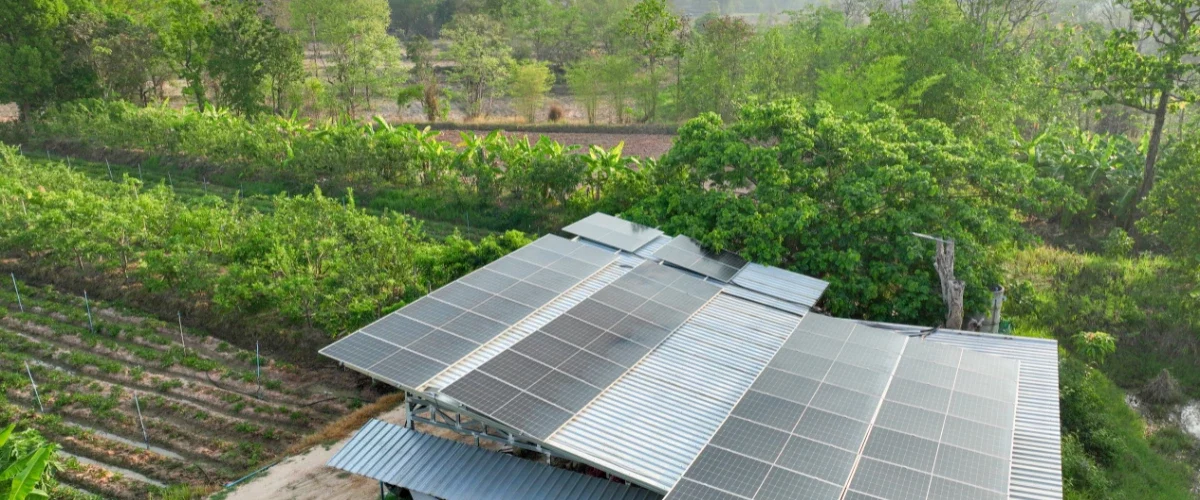
Agrivoltaics, also known as agri-PV or dual-use solar, involves installing photovoltaic panels above, between or alongside crops and grazing areas.
Unlike conventional ground-mounted solar installations, which may limit other uses of the land, agrivoltaic systems are designed to maintain agricultural activity while generating electricity.
In Murcia, southeastern Spain, researchers are studying how solar installations interact with crops including peppers, grapes and dragon fruit.
The systems can provide partial shade, reduce exposure to extreme heat and help retain soil moisture. These benefits may be particularly valuable in regions experiencing rising temperatures and increasing water stress.
Research from Germany’s Fraunhofer Institute for Solar Energy Systems indicates that agrivoltaics can improve land-use efficiency by producing food and electricity on the same site. However, the outcome depends on panel spacing, height, orientation and the amount of sunlight available to crops.
A 2025 scientific review published in Nature Reviews Clean Technology similarly found that agrivoltaics can offer agricultural and economic benefits, although poorly designed systems may reduce crop productivity.
European investment in agrivoltaics expands
European governments and private companies are investing in agrivoltaic projects as part of broader efforts to expand renewable electricity generation.
Euronews reported that Amazon and Apple have entered electricity purchase agreements associated with large agrivoltaic projects in southern Italy, representing more than 150 MW of combined generating capacity.
Public funding is also supporting development. Italy has secured approximately €1.7 billion in state aid for agrivoltaic initiatives, while the European Union-backed AGRISOL project is expected to invest €1.9 million in related activities, including projects in Italy and Spain.
The investments reflect growing interest in solar systems that can operate alongside agricultural production rather than replacing it.
A 2023 European study estimated that agrivoltaics could theoretically generate substantially more electricity than Europe’s current demand if widely deployed across suitable agricultural land.
However, such estimates represent technical potential rather than realistic deployment forecasts. Actual development would depend on grid availability, agricultural requirements, investment costs and land-use restrictions.
Solar panels could improve crop resilience
Agrivoltaic systems may offer agricultural benefits beyond additional electricity revenue.
Solar panels can provide shade that reduces soil evaporation and protects certain crops from excessive sunlight. Depending on their design, elevated installations may also offer some protection against hail and extreme weather.
In water-stressed agricultural regions, these effects could become increasingly important.
Researchers in Murcia found that peppers experiencing water stress performed better under certain solar panel arrangements than comparable crops exposed to full sunlight.
However, the findings do not mean every crop benefits from partial shading.
Some plants require high levels of direct sunlight, and poorly positioned panels can reduce photosynthesis and agricultural yields.
A 2025 study published in Renewable Energy examined different agrivoltaic configurations for winter wheat and sugar beets. The researchers found that panel arrangement and spacing significantly affected crop performance, with some designs improving yields compared with more densely arranged agrivoltaic systems.
The findings emphasize the importance of selecting appropriate crops and designing installations around local agricultural conditions.
High installation costs remain a challenge
Despite its potential benefits, agrivoltaics can be more expensive to develop than conventional ground-mounted solar projects.
Elevated mounting structures, wider panel spacing and specialized equipment can increase construction costs.
The 2025 Nature Reviews Clean Technology study found that agrivoltaic installations can cost approximately 20% to 90% more than conventional photovoltaic systems, depending on their configuration.
Developers must also account for the needs of agricultural machinery, irrigation infrastructure and ongoing farming operations.
These additional requirements can affect project profitability, particularly for smaller farms with limited access to financing.
Agrivoltaics may provide new revenue opportunities through electricity sales or land leasing, but the financial benefits are not necessarily distributed equally between landowners, farmers and energy developers.
Concerns emerge over farmland ownership and local benefits
Euronews also highlighted concerns among European agricultural organizations about the increasing involvement of large investors in agrivoltaic development.
Some farming representatives argue that solar development does not address underlying challenges facing European agriculture, including low farm incomes, rising operating costs and difficulties accessing land.
There are also concerns that projects marketed as agrivoltaics could prioritize electricity generation while maintaining only limited agricultural activity.
To address these risks, several European countries have introduced requirements intended to preserve productive farming.
France requires qualifying agrivoltaic projects to maintain agricultural production relative to established reference yields, while Italian rules establish minimum requirements for continued agricultural land use.
Researchers emphasize that project evaluation should consider agricultural productivity, environmental effects and benefits to local communities alongside electricity generation.
Agrivoltaics offers opportunities but requires careful planning
Agrivoltaics could help Europe expand solar capacity while reducing pressure on agricultural land, particularly in regions where suitable land is limited and climate conditions threaten crop production.
The approach may also provide farmers with additional income and improve resilience against heat and water shortages.
However, its effectiveness depends on whether projects maintain meaningful agricultural production and deliver measurable benefits to farmers.
Research suggests that agrivoltaics should be evaluated according to local crop requirements, environmental conditions, installation costs and community needs rather than treated as a universal solution.
As European countries pursue renewable energy expansion, agrivoltaics is emerging as one option for balancing electricity generation with agricultural land preservation.
REQUEST FOR QUOTE | Contact Us
Sources
- Euronews, Farming and solar power are competing for land
- U.S. Department of Energy, Agrivoltaics: Solar and Agriculture Co-Location
- Fraunhofer ISE, Agrivoltaics: Opportunities for Agriculture and the Energy Transition
- Nature Reviews Clean Technology, Agrivoltaics review
- Renewable Energy, Agrivoltaic configurations and crop performance
Follow Sunhub Latest News for more solar technology and energy industry updates.






Add comment