
 Daniyal Ahmed
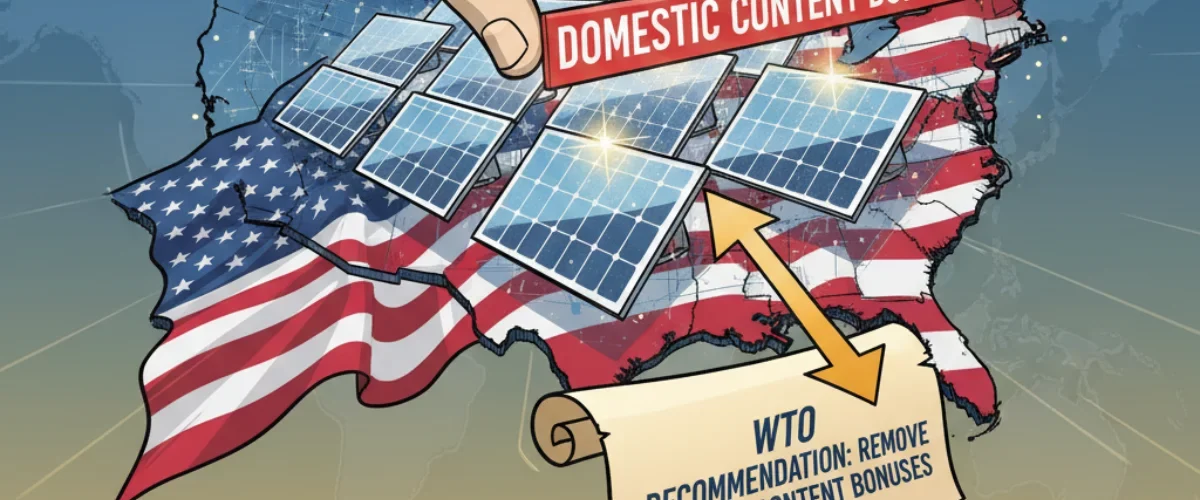
A World Trade Organization (WTO) dispute settlement panel has ruled that key clean energy tax incentives in U.S. law, including extra tax breaks for solar and other renewable projects that use American-made components, violate international trade agreements and should be removed by October 1, 2026.
The ruling stems from a complaint filed by China in March 2024 alleging that certain provisions of the U.S. Inflation Reduction Act (IRA) discriminate against imported goods by offering domestic content bonus tax credits tied to the Investment Tax Credit (ITC) and Production Tax Credit (PTC). According to the dispute panel, those bonus credits conflict with multiple WTO agreements, including the General Agreement on Tariffs and Trade (GATT 1994), the Agreement on Trade-Related Investment Measures (TRIMs), and the Agreement on Subsidies and Countervailing Measures (SCM).
What the ruling found
In its January 30 report, the WTO panel concluded that the U.S. bonus credits violate trade rules because they condition additional tax incentives on the use of U.S.-produced inputs, effectively treating imported products less favorably than domestic ones. The panel specifically identified the ITC/PTC Domestic Content Bonus Credits as inconsistent with WTO obligations, stating that the United States failed to justify the measures under any recognized trade exception.
Under WTO rules, member countries must not discriminate against imported products in internal taxation or regulation in a way that gives domestic goods an advantage, unless a specific exception applies. The panel found that the United States did not demonstrate that the contested provisions were essential for the protection of public morals or otherwise justified under treaty language.
As a result, the panel recommended, but did not require, that the United States withdraw the domestic content bonus by October 1, 2026. The deadline leaves several months for Washington to change its policy in advance of enforcement.
Background: Solar tax incentives and domestic content
The domestic content bonus was created under the IRA, landmark climate and clean energy legislation passed in 2022, to encourage renewable energy manufacturing in the United States and bolster supply chains for technologies such as solar panels, wind turbines and energy storage. The bonus offers additional tax credit percentages for projects that use a certain threshold of U.S.-made components, above and beyond the base credits available to all qualifying clean energy projects.
Supporters of the bonus argue that it incentivizes domestic manufacturing and strengthens U.S. supply chains, especially in the face of global competition. The provision was part of a suite of clean energy incentives intended to accelerate decarbonization and domestic industry growth.
However, critics, including the WTO panel and China’s government, say that tying tax benefits to domestic production disadvantages foreign manufacturers and violates international trade obligations. The issue has drawn attention because it highlights a broader tension between climate policy goals and global trade rules.
Reactions from Washington and Beijing
Following the panel report’s release, the Office of the United States Trade Representative (USTR) issued a statement expressing strong disagreement with the WTO findings. The statement characterized the ruling as “absurd,” arguing that it fails to address “China’s industrial policies and massive excess capacity” and overlooks U.S. concerns about ensuring fair competition. USTR officials reaffirmed U.S. commitment to defending domestic industries and securing supply chains. (Solar Power World)
Chinese officials welcomed the WTO panel’s decision, calling it fair and urging the United States to implement the recommendations promptly. Beijing has pressed the case as necessary to protect Chinese manufacturers’ interests and preserve a level playing field in global clean energy markets. (Moneycontrol)
Appeals and WTO enforcement challenges
Technically, both China and the United States have the right to appeal the ruling. However, the WTO’s Appellate Body, the trade organization’s top appeals tribunal, remains nonfunctional because the United States has blocked appointments to the panel, leaving no judges to hear appeals. As a result, WTO dispute resolution effectively lacks a final review step, meaning panel rulings stand but cannot be appealed or fully enforced under traditional WTO mechanisms. (pv magazine International)
Implications for U.S. clean energy policy
The WTO panel report has significant implications for how the United States structures federal clean energy incentives going forward. If the domestic content bonus is removed or significantly altered, developers of solar and other renewable projects may face changes in their tax credit eligibility and financial planning. The decision also highlights the broader tension between domestic industrial policy and global trade rules, a conflict that could influence future climate legislation and international trade negotiations.
For industry stakeholders, the deadline for compliance in October 2026 provides time to anticipate policy adjustments, engage with trade officials, and assess how changes might affect project economics, supply chains, and long-term investment strategies.


 Cody Cooper



Add comment