
 Daniyal Ahmed
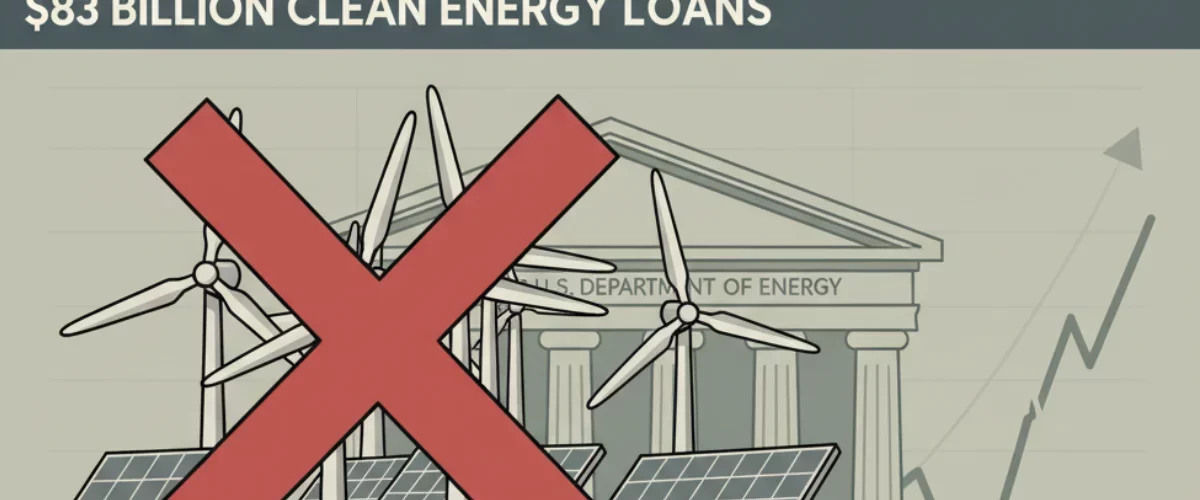
The U.S. Department of Energy (DOE) has announced the cancellation or major revision of over $83 billion in clean energy loan commitments made under the previous administration, marking one of the most sweeping restructurings of federal energy financing in recent years. The move reflects a significant shift in federal energy policy, as the DOE redirects funding priorities toward fossil fuel and nuclear power projects, while rolling back many clean energy loans originally slated to support solar, wind and other renewable technologies.
In a statement, DOE Secretary Chris Wright said the department had conducted a year-long review of the federal loan portfolio and determined that much of the clean energy financing approved late in the Biden administration was issued too hastily and did not meet “responsible investment” standards. The review covered approximately $104 billion in principal obligations that had been authorized by the DOE’s Loan Programs Office before its restructuring.
“We found more dollars were rushed out the door of the Loan Programs Office in the final months of the prior administration than had been disbursed in over fifteen years,” Wright said in remarks cited by DOE officials. He added that the restructuring aligns with the department’s renewed mission to support projects that contribute to affordable, reliable and secure energy for American consumers.
Revisions and eliminations in loan portfolio
Of the original loan commitments, an estimated $29.9 billion has already been formally rescinded or de-obligated, while another $53 billion is being revised under new lending criteria, according to DOE and Energy Dominance Financing officials.
About $9.5 billion of the funding that had been earmarked for wind and solar projects is being eliminated outright, with DOE indicating that some of these commitments will be replaced by support for nuclear and natural gas uprate projects, investments that the department says will provide more stable and affordable energy outputs.
The department has also confirmed the cancellation of specific large-scale clean energy loans. Among these is a previously announced $1.8 billion loan to Arizona Public Service (APS) intended for transmission upgrades, renewable generation and grid-integrated energy storage, which is now being withdrawn. Federal records describe this decision as part of the broader restructuring of the loan portfolio.
Policy context and industry reaction
The cancellations come amid a broader shift in U.S. energy policy under the current administration, which has reprioritized federal support toward traditional energy sources and grid reliability investments. The DOE’s Office of Energy Dominance Financing, successor to the Loan Programs Office, now emphasizes financing for projects that the administration believes will lower costs and strengthen national energy security. The office also reports having more than $289 billion in remaining loan authority for future commitments.
The Solar Energy Industries Association (SEIA), the principal trade organization representing U.S. solar companies, has criticized the rollbacks, arguing that solar and other renewables represent some of the fastest-deploying and most cost-effective means of meeting rising electricity demand. Industry data show that solar alone has been driving significant new capacity additions to the U.S. grid, even outpacing fossil fuel deployment over the past two years.
Clean energy advocates have warned that the cancellations could slow the pace of decarbonization and undermine investment certainty for renewable developers, particularly at a time when federal tax incentives have also been scaled back under recent legislation.
Economic and grid implications
Economists and energy analysts say that rolling back large portions of the federal clean energy financing portfolio could have a range of effects on U.S. energy markets. Short term impacts may include reduced access to affordable capital for utility-scale solar, wind and battery storage projects, potentially slowing deployment and increasing reliance on private financing sources. Long term, some analysts contend that shifting support toward natural gas and nuclear projects could alter the mix of capacity added to the grid through the end of the decade.
Critics of the policy changes argue such a shift may delay emissions reductions and slow the economic growth associated with clean energy manufacturing and installation — sectors that have supported tens of thousands of jobs and substantial private investment in recent years. Conversely, supporters of the DOE’s new approach contend prioritizing reliability and cost reduction may help stabilize consumer energy prices and enhance grid resilience.
What comes next
With much of the Biden-era loan portfolio now subjected to revision or elimination, the pace of new federal loan guarantees for clean energy remains uncertain. DOE officials say they will focus on projects that align with current national priorities, suggesting future financing may target infrastructure upgrades, grid modernization and select fossil or nuclear capacity enhancements.
As the energy sector adjusts to these policy shifts, both proponents and detractors are expected to press for legislative and regulatory clarity in 2026, particularly as debates continue over how best to meet U.S. energy needs while balancing cost, reliability and climate commitments.
Sources:
- DOE cancels $83.6 billion in clean energy loans (Solar Power World Online) (Solar Power World)
- DOE to ‘rein in’ more than $83 billion in Biden-era energy loans (Solar Builder) (Solar Builder Magazine)
- DOE cancels $1.8B loan to Arizona Public Service (Utility Dive) (Utility Dive)



 Kadeer Beg
 Cody Cooper



Add comment