
 Daniyal Ahmed
Solar farmland – Solar development occupies only a small fraction of American farmland, according to a new analysis released by the Solar Energy Industries Association (SEIA), challenging concerns that large-scale solar deployment is significantly reducing agricultural land availability. The findings were published through a new interactive mapping tool that examines solar development on farmland across the United States.
SEIA found that solar projects currently occupy approximately 0.07% of U.S. farmland and about 0.04% of the nation’s total land area. The analysis comes amid ongoing discussions surrounding the 2026 Farm Bill and increasing scrutiny of utility-scale solar development on agricultural land.
According to the data, no state has more than 0.5% of its prime farmland dedicated to solar energy projects. Even in states with the highest levels of solar development, farmland devoted to solar remains a small percentage of available agricultural land. California and Rhode Island recorded some of the highest shares of prime farmland used for solar, but both remained below one-half of one percent.
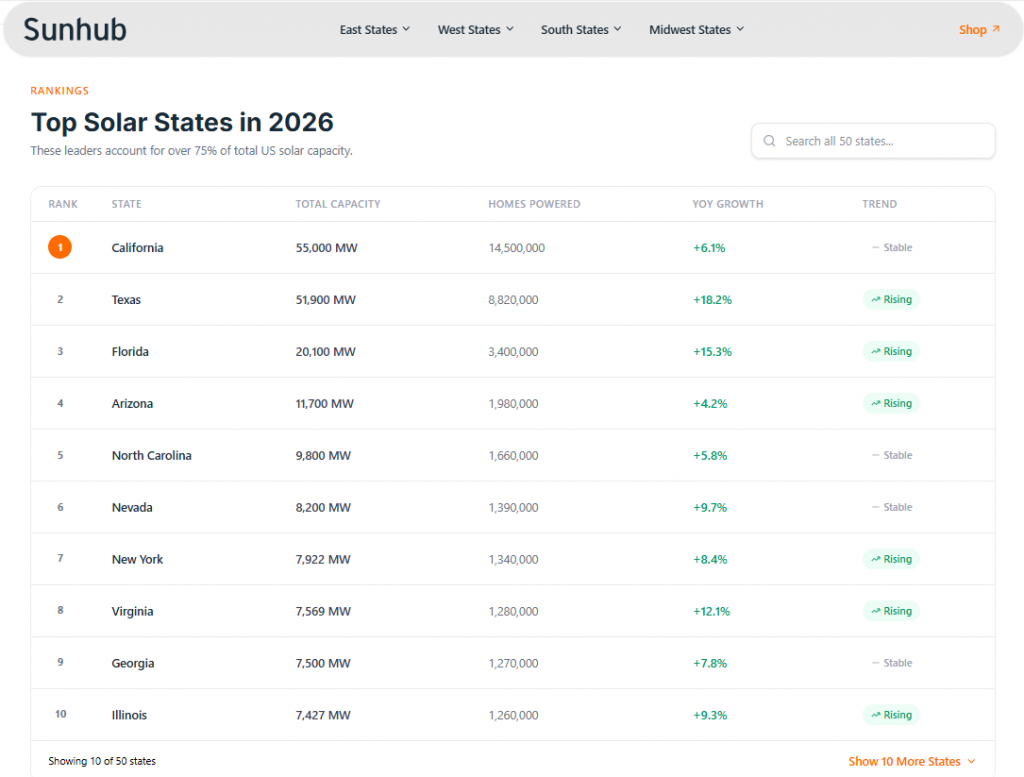
Explore U.S. Solar State Rankings
Compare solar rankings, installed capacity, growth trends, and market performance across all 50 states. Discover regional insights to support smarter procurement and expansion decisions.
The report also compared solar development with other land uses. SEIA found that golf courses occupy roughly 2.6 times more prime farmland than solar projects, while suburban development since 2014 has consumed significantly more agricultural land than solar installations. The organization noted that for every acre of prime farmland currently used for solar generation, there are approximately 43 acres of abandoned prime farmland across the country.
Many solar projects are also designed to support agricultural activity through dual-use approaches such as livestock grazing, pollinator habitats, and agrivoltaic systems that allow farming operations to continue alongside energy production. Industry advocates argue that these projects can provide farmers with additional revenue streams while maintaining agricultural productivity.
The findings arrive as lawmakers debate agricultural and energy policy measures that could affect future solar development on farmland. Some proposals have sought to limit federal support for solar projects on prime agricultural land, citing concerns about preserving farmland for food production. Supporters of solar development argue that the data show solar’s land footprint remains relatively small compared with other forms of development and land conversion. (The Guardian)
SEIA said the mapping tool is intended to provide policymakers, landowners, and local communities with more accurate information about solar land use as the United States continues expanding renewable energy generation. The organization maintains that solar can play a growing role in the nation’s energy mix while occupying only a minimal share of agricultural land.
Fact check: The core claim is accurate. Multiple independent reports, including SEIA’s mapping analysis and coverage by pv magazine USA, confirm that utility-scale solar currently occupies about 0.07% of U.S. prime farmland, not 1%. The Solar Power World headline understates the figure by saying “less than 1%,” but the actual reported value is substantially lower at 0.07%. (pv magazine USA)
Sources: Solar Energy Industries Association (SEIA); Solar Power World; pv magazine USA; American Clean Power Association. (Solar Power World)


 Marley Kakusa
 Cody Cooper



Add comment