
 Kadeer Beg
Energy costs remain one of the largest operational expenses for many businesses. From manufacturing facilities and warehouses to office buildings and retail centers, organizations are constantly looking for ways to improve efficiency, lower operating costs, and strengthen long-term financial performance. One of the most effective strategies available today is investing in commercial solar solutions.
Commercial solar systems allow businesses to generate their own electricity, reduce dependence on utility providers, and improve energy resilience. As solar technology continues to advance and installation costs become more competitive, commercial solar is increasingly viewed as both an energy solution and a financial asset.
This guide explores commercial solar solutions, how they work, their benefits, available technologies, and what businesses should consider when evaluating a solar investment.
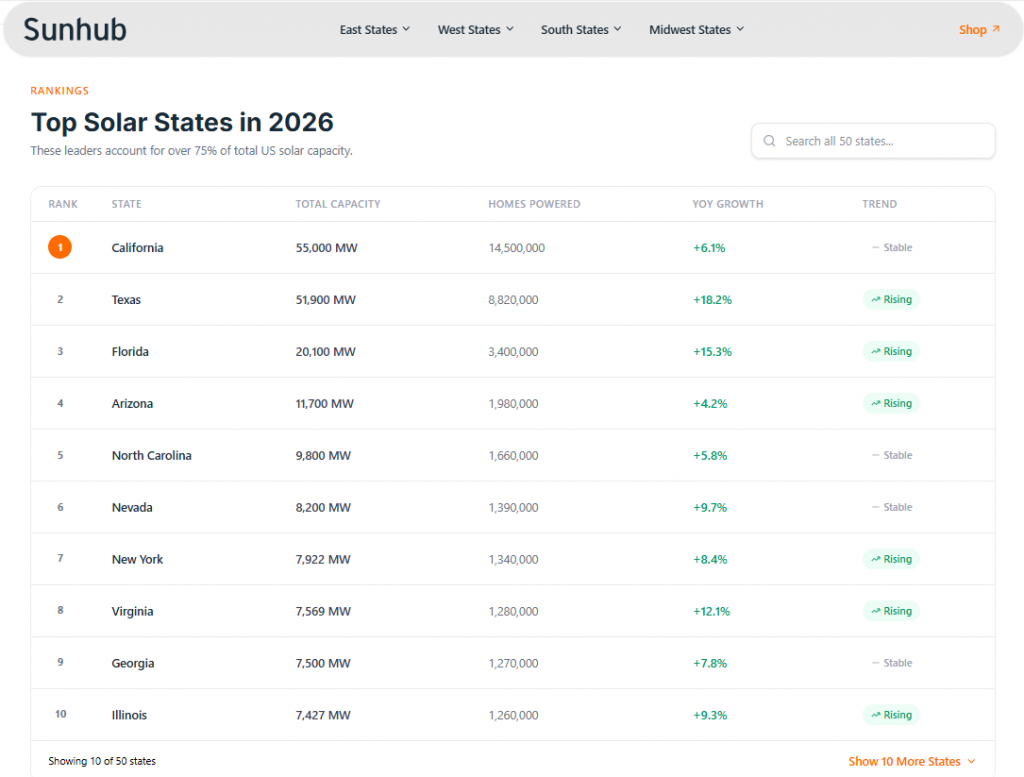
Explore U.S. Solar State Rankings
Compare solar rankings, installed capacity, growth trends, and market performance across all 50 states. Discover regional insights to support smarter procurement and expansion decisions.
What are commercial solar solutions?
Commercial solar solutions refer to solar energy systems specifically designed for businesses, organizations, and large facilities.
Unlike residential systems, commercial solar installations are often larger and more complex, with the goal of offsetting a significant portion of a company’s electricity consumption.
Commercial solar projects can include:
- Rooftop solar systems
- Ground-mounted solar arrays
- Solar carports
- Battery energy storage systems
- Energy monitoring and management platforms
According to the U.S. Department of Energy, commercial solar installations play a critical role in reducing electricity costs while supporting broader clean energy adoption.
Why businesses are investing in commercial solar
Several factors are driving increased adoption of commercial solar solutions.
Rising electricity costs
Utility rates have increased across many regions, creating pressure on operating budgets.
Solar energy helps businesses:
- Stabilize long-term energy costs
- Reduce monthly utility expenses
- Improve budgeting predictability
Sustainability goals
Many organizations have established environmental, social, and governance (ESG) objectives.
Commercial solar helps companies:
- Reduce carbon emissions
- Demonstrate sustainability leadership
- Meet corporate environmental commitments
According to the International Energy Agency (IEA), solar PV remains one of the fastest-growing renewable energy technologies globally.
Energy resilience
Power outages can create significant operational disruptions.
Commercial solar systems paired with battery storage can provide:
- Backup power
- Reduced downtime
- Improved business continuity
Financial returns
Unlike many operational expenses, solar systems often generate measurable long-term savings and attractive returns on investment.
Types of commercial solar solutions
Commercial solar projects can be customized based on facility size, energy usage, and available space.
Rooftop solar systems
Rooftop solar remains one of the most common commercial solar solutions.
Advantages include:
- Utilization of existing roof space
- Minimal land requirements
- Lower site preparation costs
Common applications include:
- Warehouses
- Distribution centers
- Manufacturing facilities
- Office buildings
Ground-mounted solar systems
Ground-mounted arrays are installed on available land adjacent to facilities.
Benefits include:
- Larger system capacities
- Easier maintenance access
- Optimal panel orientation
These systems are commonly used by:
- Industrial facilities
- Agricultural operations
- Large commercial campuses
Solar carports
Solar carports combine energy generation with covered parking.
Benefits include:
- Additional solar generation space
- Vehicle protection
- Enhanced property value
Solar carports are increasingly popular at:
- Universities
- Hospitals
- Shopping centers
- Corporate campuses
Commercial battery storage systems
Battery storage is becoming a major component of modern commercial solar solutions.
Benefits include:
- Peak demand reduction
- Backup power capability
- Improved energy management
- Greater solar self-consumption
The U.S. Energy Information Administration (EIA) reports significant growth in battery storage deployment as businesses seek improved energy flexibility.
How commercial solar systems work
Commercial solar systems follow the same basic principles as residential solar but operate at a larger scale.
Step 1: Solar panels generate electricity
Photovoltaic (PV) panels convert sunlight into direct current (DC) electricity.
Step 2: Inverters convert electricity
Solar inverters convert DC power into alternating current (AC) electricity for business operations.
Step 3: Energy is consumed on-site
Generated electricity powers equipment, lighting, HVAC systems, and other loads.
Step 4: Excess energy is managed
Excess power may:
- Charge batteries
- Be exported to the grid
- Support demand management strategies
Key benefits of commercial solar solutions
Reduced operating expenses
Electricity savings are often the primary reason businesses invest in solar.
Many commercial facilities offset a substantial portion of their utility bills through solar generation.
Improved return on investment
Solar systems can generate savings for 25 years or longer.
According to the National Renewable Energy Laboratory (NREL), modern commercial solar systems continue delivering value long after installation costs are recovered.
Energy cost predictability
Solar reduces exposure to fluctuating utility prices.
This helps businesses forecast future operating expenses more accurately.
Enhanced property value
Commercial properties with solar installations may become more attractive to tenants and investors.
Sustainability leadership
Solar projects support corporate sustainability initiatives and demonstrate environmental responsibility.
Commercial solar financing options
Businesses have several financing options available.
Direct purchase
The company owns the system outright and receives all energy savings.
Solar loans
Financing spreads installation costs over time while allowing ownership benefits.
Power purchase agreements (PPAs)
A third party owns the system and sells electricity to the business at a predetermined rate.
Solar leases
Businesses pay a fixed monthly fee to use the solar system.
Each financing model offers different benefits depending on business objectives and capital availability.
Factors to consider before investing
Energy usage profile
Businesses should understand:
- Annual electricity consumption
- Peak demand periods
- Future energy growth projections
Roof condition
Older roofs may require repairs before solar installation.
Available space
System size depends on:
- Roof area
- Land availability
- Structural considerations
Local regulations
Permitting, utility interconnection requirements, and local incentives can affect project economics.
Emerging trends in commercial solar solutions
Solar plus storage
More businesses are combining solar with battery systems to improve resilience and maximize savings.
Smart energy management
Advanced software platforms now optimize:
- Solar generation
- Battery usage
- Building energy consumption
EV charging integration
Many commercial facilities are integrating solar-powered EV charging infrastructure.
Virtual power plants
Commercial batteries may increasingly participate in utility demand-response and grid-support programs.
Are commercial solar solutions worth it?
For many businesses, the answer is yes.
Commercial solar solutions offer:
- Lower electricity costs
- Long-term financial savings
- Energy resilience
- Sustainability benefits
The strongest returns are often achieved by organizations with:
- High daytime electricity usage
- Large roof or land availability
- Long-term facility ownership plans
Conclusion
Commercial solar solutions have evolved from niche sustainability projects into mainstream business investments. As electricity costs rise and clean energy adoption accelerates, more organizations are turning to solar to improve operational efficiency and long-term financial performance.
Whether through rooftop installations, ground-mounted arrays, solar carports, or battery storage systems, commercial solar provides businesses with a powerful tool for controlling energy costs and supporting sustainability goals.
For companies evaluating future energy strategies, commercial solar solutions remain one of the most effective ways to improve both environmental and financial outcomes.
FAQs
What are commercial solar solutions?
Commercial solar solutions are solar energy systems designed specifically for businesses, organizations, and commercial facilities.
How much can a business save with commercial solar?
Savings vary by system size, electricity rates, and energy usage, but many businesses significantly reduce their utility costs over the system’s lifespan.
Can commercial solar systems include battery storage?
Yes. Many modern commercial installations integrate battery systems for backup power and demand management.
What is the lifespan of a commercial solar system?
Most solar panels are designed to operate for 25–30 years or longer.
Are commercial solar projects financially worthwhile?
For many businesses, solar provides strong long-term returns through reduced electricity costs and improved energy predictability.

 Daniyal Ahmed
 Marley Kakusa
 Cody Cooper



Add comment